Jason Collins and Chris Broussard: Cultural Symbols in a Polarized Nation

I’ve always said that sports reflects culture. If there are certain worldviews and trends that seem pervasive in other sectors of mainstream society—government, media, pop culture—we will usually see them appear in sports as well. Right now, this theory is once again being validated.

On Monday, NBA basketball player Jason Collins announced publicly in a Sports Illustrated article that he considers himself gay. To many people, this was inevitable and long overdue—not that Collins himself would announce he is gay, but that someone currently playing professional sports would make this announcement. After all, the thinking goes, homosexuality is normal and natural. Surely, someone somewhere in a professional sports uniform is silently living as a homosexual, and eventually they will come out. We don’t know who it is, and we don’t really care. We just want someone to do it.

Well, the inevitable has finally happened. His name is Jason Collins.

Yet for all this, there was a second inevitability, dependent on the first. Just as there had to be a hero who had the “courage” to wear his homosexuality on his sleeve, there also had to be a villain who was despicable enough to publicly disagree with and even condemn the hero’s declaration. Well, we have our villain—Chris Broussard.

Following Collins’ announcement yesterday, ESPN basketball analyst Chris Broussard was asked on camera to comment. Why Broussard? Well, the obvious answer is that he is an NBA analyst and this is an NBA story. So it makes sense, right? But it quickly became clear that there was an even more specific reason ESPN chose Chris Broussard—and not, say, Jon Barry—to comment on Collins’ coming out.

You see, Chris Broussard has been very open about the fact that he is an evangelical Christian. That is, Broussard believes the gospel is uniquely true and that the Bible has complete authority. Most importantly, he has turned from willfully sinning and is trusting Jesus Christ alone for forgiveness and reconciliation with God.

So, when Jason Collins announced his homosexual lifestyle, ESPN saw an opportunity that was too good to pass up. On Monday’s edition of ESPN’s Outside The Lines, Broussard was asked to comment on Jason Collins’ claims to be both homosexual and a Christian. And here is how Broussard responded:

It is striking that when confronted with the question of homosexuality, the first words out of Broussard’s mouth are, “I’m a Christian.” He then provides a cogent summary of the Bible’s stance on homosexuality and unrepentant sin in general, noting particularly that the Bible expressly forbids people living in open sin and yet claiming to be Christian. As he makes the biblical case, Broussard registers his own assent to the Bible’s teaching. For Broussard, his stance on the matter is the Bible’s stance. For Christians, it can be no other way.

Not surprisingly, the backlash against Broussard has been sweeping and vitriolic. On Twitter, Broussard has been called almost every derogatory name one could imagine—many of them too heinous for me to repeat. Among his sports journalism peers, Broussard has been ostracized, with many people calling for him to be fined, suspended, or even fired. Indeed, the pervasive “tolerance” movement is once again driving its stake in the ground, just as it has done on so many other matters. And each time, the rhetoric is more extreme, more hateful—more intolerant to the minority who does not share the views of the majority. The irony is deep here.

But what is perhaps most interesting about the Collins-Broussard situation is the position of professional sports as an emblem of progress, or lack thereof, in society as a whole. What is true in sports must be true in society, and vice versa.

To be sure, there are many who desperately reject such a notion. Sports, it is thought by some, is one of the few spheres of public life in which one’s views on matters like race, religion, and sexuality are completely irrelevant. But we know better than this. For as the public debate over same-sex marriage has continued to heat up, there has been an increasing ground swell of people in sports clamoring for a brave soul who will finally break the “sexuality barrier” and become yet another powerful public symbol of America’s inevitable march toward complete normalization and integration of the homosexual lifestyle.

In order to finally achieve our ultimate aims, we need symbols—people, events, or objects that show us and those around us that our cause is authentic, legitimate, and achievable. On April 29, 2013, Jason Collins became that symbol in the realm of sports. The same-sex agenda already has its public symbols in the film, television, and music industries. The political sector has also provided its own share of high-profile symbols.

The only shoe that hadn’t dropped yet was sports. Advocates of same-sex marriage needed a public, high-profile symbol in one of the “big four” sports (i.e. football, basketball, baseball, hockey). And they got it. Make no mistake about it: Jason Collins now stands for something much bigger than himself. For many people in this country, he has become a living, breathing sign post that says same-sex attraction is normal, legitimate, and demanding of full, unqualified acceptance.

If Jason Collins is a symbol, then there is a flip side to that coin. Chris Broussard is also a symbol. When the news of Collins’ announcement became public, ESPN jumped at the opportunity to record a dissenting opinion from within the realm of sports. Why? Because every hero needs a villain to highlight the moral virtue of the hero’s cause. And that’s precisely what has happened. Broussard had barely finished articulating his position before hordes of people took to social media to register their moral outrage. For the mainstream pro-gay agenda, Broussard’s statement was a gift. It has served to further galvanize an ever-increasing consensus in favor of embracing the “tolerant” same-sex agenda.

For Christians, Broussard’s plight is a stark reminder of what we already know. That is, the era of Christian privilege in America has come to an end. We Christians have become a despised minority. It appears we are now entering a period of unprecedented marginalization of evangelicals in this nation. A clear line is being drawn right before our very eyes. More and more, the biblical worldview will be considered categorically incompatible with American ideals. As a result, there will no longer be a place in American public life for those of us who believe in the supreme authority of the Bible and the unique truth and saving power of the gospel.

Thankfully, God’s Word has prepared us to face such opposition:

Blessed are you when people hate you and when they exclude you and revile you and spurn you name as evil, on account of the Son of Man! Rejoice in that day, and leap for joy, for behold, your reward is great in heaven; for so their fathers did to the prophets.

– Luke 6:22-23

Though Jesus here was speaking directly to a crowd of Jews in the first century, the lesson applies to us today. Following Christ and opposing unrighteousness will get you hated. And when that happens, remember your heavenly reward and let that be cause for joy. God himself is our great reward, and he is worth all our allegiance, even when it costs us everything in this world.

I applaud Chris Broussard for taking a courageous stand for biblical truth in the midst of vehement opposition. His struggle is our struggle. He is a pronounced symbol for what we will now face every day in every place. Yes, he is a symbol. But what our mainstream society has intended to be a symbol of our defeat, is actually a symbol of our joy-filled suffering in anticipation of the ultimate vindication of our righteous cause.

This Week in Sports – 4/26/2013

Teddy Kremer and the Exploitation of Disabled Persons in Sports

This week, Sports Illustrated ran an interesting piece about how positive media responses toward feel-good stories in sports have sometimes led to athletes and teams exploiting persons with disabilities for the sake of garnering positive media attention. The focus of the article is last week’s heartwarming story about Teddy Kremer, a 30-year old man with Down syndrome who was chosen to be an honorary batboy for the Cincinnati Reds. Kremer reportedly asked Reds third baseman Todd Frazier to hit a home run for him. Frazier delivered, hitting a homer in the sixth inning to put the Reds up 11-1. Teddy bounded exuberantly toward home plate where he met Frazier and offered his congratulations in front of the home crowd. You can’t script a better story.

It’s true, we love tear-jerking stories like this, and we love organizations like the Cincinnati Reds for their acts of kindness. But is there a point where it becomes exploitative toward those with disabilities? Does our well-meaning intent to be charitable toward the less fortunate become a self-serving means of stroking our own ego and making the headlines? Perhaps. But this does not mean we should be hesitant to show kindness. Rather, we should be all the more thoughtful to ensure, as far as we are able, that our charitable gestures are both genuine and actually helpful. This is true in sports and all other areas of life.

Read the entire Sport Illustrated article here.

_______________________________________________________________________________

Ovie Nets a Beauty Against Ottawa

Watch this…

Alex Ovechkin, captain of the Washington Capitals, scored this ridiculous goal last night against the Ottawa Senators. Hockey fan or not, you’ve got to appreciate this kind of athleticism. Of course I am biased, but it’s good to see that Ovechkin is back to his old self.

________________________________________________________________________________

Top 10 Dunks of the NBA Playoffs – First Round

LeBron+James+Miami+Heat+v+Milwaukee+Bucks+kP9qsB4b9j_l

Full disclosure: I’m not a huge fan of the NBA. But I do love some good, violent dunks. Here are the NBA’s Top 10 dunks from the first round of the playoffs.

________________________________________________________________________________

Can the Nats Handle the Pressure?

Baseball season, as the saying goes, is a marathon, not a sprint. Still, with only 18 games in the books, I am already beginning to wonder if it is time to worry about the Washington Nationals.  After being swept by the Atlanta Braves and struggling to take just 1 of 3 games from the New York Mets, the Nats now own a very mediocre 10-8 record. Though expectations for this club are in the stratosphere, the Nats have limped through April with a multitude of unforeseen problems. Bad pitching, throwing errors, poor base-running. To make matters worse, Atlanta is having their best start to a season in about two decades.

Indeed, it appears that this Washington Nationals club is in some trouble. But is it time to panic? Not yet. At least, that’s what famed Washington Post sports columnist Tom Boswell seems to think. Earlier today, Boswell hosted a live chat during which he was asked whether or not he is worried about the Nats. Here is just a snippet of Boswell’s long, detailed response:

The Nats are playing poorly. Not atrociously. But they are lucky to be 10-8. Their actual play probably deserves 8-10 or worse. They are overanxious at the plate in tight games, like Werth swinging at a 3-0 pitcher’s pitch in the 8th on Sunday to kill a rally with a GIDP. They make base-running blunders or misjudgments, like Span getting throw out at 2nd by 8 feet on Sunday. Or they make errors on simple plays, like Desmond’s wide throw to 1st on Sunday. Or they have a lapse of concentration, like Harper’s embarrassing misplay of a routine single yesterday. Or they have an almost team-wide case of poor command of pitches, which sometimes means you’re just trying too hard.As is almost always the case when good teams play this way, it is NOT aa case of not trying hard enough or not caring enough. It is almost always the opposite — trying too hard, trying to “pick up the team” too much by doing too much yourself. It’s just April, for crying out loud. Just relax and play the game and enjoy. But that is far harder to do than to say.

I tweeted yesterday during the game that:  “the Nats must make 3-4-5 brutal mental mistakes or errors on easy plays in most of their games. 5 today. Pressing in April. Expectations rob joy.”

I got an e-mail after the game from a Nationals fan who said that she felt the team missed Michael Morse’s loose presence and felt it was obvious that the Nats were pressing, trying too hard, burdened by expectations — a team of analytical introverts who “need a clown” to help them relax.

I think that’s probably close to the case but not something that’s going to be as easily fixed as a few practical jokes or more chuckles on the bench. The Nats may miss Mark DeRosa as much as Morse.He was smart (Wharton degree), tough (Penn QB) and funny in a clubhouse way that seemed spontaneous but was also always part of setting team tone. It’s rare to see a player who doesn’t produce much, like DeRosa, who’s part of chemistry.

BUT the primary problem, IMO, is not the absence of Morse (or any one else). It’s the introduction of high expectations, criticism, judgment, Game 5. Some teams aren’t especially bothered by it. The Nats seem to be. You can’t know its importance until you see it play out. The reason that “expectations rob joy” is kind of a cliche is because it’s true. The Nats will have to learn to deal with it.

I like Boswell’s line of thinking, and it’s fairly similar to thoughts I’ve been having lately about the Nats. The Washington Nationals are victims of the extremely high expectations of baseball fans and and media in DC and beyond.

To be fair, high expectations are perfectly reasonable for a club as good as the Nats. The roster is talented, deep, and well-built. And considering that the front office somehow managed to improve in the offseason on a roster that already had such little downside, it only makes sense that many fans and media everywhere consider anything other than a World Series appearance to be a failure for this team. Indeed, one could argue that the Nationals, at least on paper, are unbeatable over the long haul.

Still, these are humans we’re talking about. Aside from the hours spent at the ballpark each day, these players have a lot of time on their hands. And to fill that time, they watch SportsCenter, they read the papers, and they listen to the sports talk radio stations. For anyone to assume otherwise would be somewhat naive. And as they tune into the media commentary, they are bombarded with the unrelenting pressure that comes with being at the top.

The Nats have a huge target painted on their backs, and they know it. All eyes in the National League are focused on them. There is no margin for error. Is this pressure, or at least the Nats’ perception of it, the reason for their struggles? I can’t say for sure. But it wouldn’t surprise me if this were a contributing factor so early in the season.

The more important question is, where will the Nationals go from here?

Only time will tell. That answer is simple and rather unsatisfactory for those who demand instant gratification. But to me, that’s the beauty of baseball. What appears to be a lost cause in April could turn out to be a gem by October. There are so many months ahead on the calendar, so much baseball yet to be played. Eighteen games, in the grand scheme, is of little account.

Still, as so many teams have discovered at summer’s end, a bad April could indeed come back to haunt you. As such, the Nationals need to get their act together—now. The good news is this: The Nationals are armed with arguably the deepest pitching rotation in baseball, a defense loaded with Gold Glove talent, multiple Silver Slugger winners, a reigning Rookie of the Year, and a manager with half a century of experience in the game.

Simply put, the Nats might look bad now, but they are definitely capable of turning things around quickly and in dramatic fashion. So, like Tom Boswell, I am certainly concerned about the Nats’ shaky start. But I am not worried. Not yet. Talk to me at the All-Star break.

__________________________________________________________________________________

Read Tom Boswell’s full article here.

Touchdown Pirates!

Here’s another heartwarming story from the world of college football. Last week, I posted about a 7 year-old cancer patient who was given a once-in-a-lifetime opportunity to run a 69-yard touchdown at the recent Nebraska Cornhuskers spring football game. Well, I hope you have another tissue box handy. As it turns out, another Division I-A college football program has decided to let a young cancer fighter take one to the house. This time, however, this honorable gesture was performed by Pirates of that most esteemed institution of higher learning— East Carolina University.

Last weekend, ECU held their annual Purple & Gold Game at Dowdy Ficklen Stadium on campus. Football-starved Pirate fans usually view the event as nothing more than an excuse to spend a nice spring day eating barbecue, drinking beer, and getting way too excited about an intrasquad scrimmage. But on the final play of the game, things took an emotional turn. Noah Roberts, an 8 year-old battling cancer, trotted out onto the field. Decked out in an ECU football jersey and helmet, Noah lined up in the tailback spot directly behind quarterback Shane Carden. Once the ball was snapped Carden handed it off to Noah, who sprinted 40 yards into the end zone.

Like Nebraska, this is another example of a big-time college football program making a classy move to give a brave kid a really cool experience. And for me, this one means even more because it’s my alma mater. There are many reasons why I am proud to be an alumnus of East Carolina University, and this most recent episode only adds to that long list.

Honoring the Legacy of John Piper

After serving for 33 years as pastor of Bethlehem Baptist Church in Minneapolis, Minnesota, John Piper is retiring from the pulpit to focus his attention on writing, speaking, and providing leadership for Desiring God Ministries.

In light of his retirement from the pastorate, Bethlehem Baptist has teamed up with Desiring God Ministries and The Bethlehem Institute to produce video tribute to John Piper. This moving, 19-minute video features testimonies from various men and women who have worked alongside John Piper and have been greatly impacted by his ministry.

My wife Suzanne edited the video. She and the team at Citygate Films produced this video in its entirety, and I consider myself blessed to have such an up-close view of their work on this and many other gospel-centered film projects for Desiring God Ministries.

As I watched the video myself, I couldn’t help but reflect on the ways John Piper’s writing and preaching have profoundly impacted me. When I became a Christian in 2003 during my freshman year in college, Piper’s book Don’t Waste Your Life was the first book I read. I didn’t know who John Piper was back then, but a friend gave me the book and encouraged me to read it. And I did read it—in one sitting. I couldn’t put it down. Piper’s radical vision of joyfully risking all make much of Christ in all of life completely revolutionized my thinking. That little book set my life on an irreversible course toward an ever-deepening sense of God’s calling on my life to make my life mean something for his glory.

It didn’t stop there. Piper has taught me, in his writing and preaching, that a deep, thoughtful, blood-earnest ferocity for the things of God is something to be sought after. He has taught me that true Christian joy has a distinct seriousness to it, and everything in life must serve the single-minded pursuit of that joy. Whether I am silent or shouting, laughing or weeping, giving or receiving, supreme happiness in God is the aim.

Piper has modeled for me a painstaking precision in reading and interpreting the Word of God. Yes, specific words are used for a reason. Sentence construction is by no means coincidental. Some Bible translations are actually better than others. These lessons were monumental for me in the formative years of my faith, and they still shape my approach to God’s Word as I now aspire to serve as a pastor myself.

To some, this may seem strange to offer such sustained praise for another human being. Indeed, some may think it doesn’t seem very Christ-exalting, but rather man-exalting. After all, isn’t John Piper simply a human instrument of God’s awesome grace. Yes! And that is precisely why I am so grateful for John Piper’s life and ministry. You see, the truth is that John Piper is just a man like me—a weak, helpless sinner who has been saved by God’s amazing mercy in Jesus Christ. And apart from Christ, John Piper’s ministry would never exist. But by God’s grace, John Piper stands as a shining example of God’s faithfulness to make his Name great in all the nations by using even those who are weakest and least significant by worldly standards.

Time and time again, John Piper has boldly proclaimed what he knows to be folly to those who are perishing, because it is wisdom and power to those who are being saved. In all my life, I can only think of a handful of men who have so boldly, consistently, graciously, and powerfully stood for gospel truth in this world. Every generation has their prophetic voices, and surely John Piper has been one for our generation.

I have never met John Piper. I hope to someday. I have a million questions for him! But even if I never meet the man face-to-face in this life, I am compelled to voice my love and appreciation for him. He has done much to point me to Christ, and I trust many others could say the same.

May God continue to bless John Piper’s ministry as he moves into a new role at Desiring God.

This Week in Sports – 4/17/13

Welcome to the first of an installment I call “This Week in Sports.” Every Wednesday, I’ll point you to some of my favorite sports headlines including the good, the bad, and the ugly. But it won’t just be about scores and statistics. Instead, it will mostly consist of in-depth analysis and human interest stories. If you ever find something that you think might be of interest to me, feel free to contact me.

_______________________________________________________________________________

Kid With Cancer Makes a Touchdown Run

If you have a pulse, then this story has got to move you. At their recent spring football game, the Nebraska Cornhuskers ran a pretty crazy trick play. Lined up on their own 31 yard-line, the Huskers offense handed the ball to seven-year-old Jack Hoffman who ran it 69 yards for a touchdown. As he crossed the goal line, Jack was met by the entire Nebraska team who hoisted him on their shoulders.

Why is this a story? Jack Hoffman is currently battling inoperable brain cancer. At the request of his parents, Jack has become part of the Nebraska football family. And his touchdown run is just his latest feat in a Huskers uniform. I’m not a Nebraska football fan, and I know very little about the program. But I have tremendous respect for them for making this happen.

For more background on this story, check out ESPN’s piece here.

________________________________________________________________________________

Georgia Releases New Rap Video ‘Dawg Bite’

In other college football news, the Georgia Bulldogs celebrated their recent spring game with the release of their new rap video called ‘Dawg Bite.’ The video prominently features head coach Mark Richt’s son. Other notable cameos include Mark Richt himself and a portly Hank Williams Jr. lookalike.

As far as I’m concerned, producing rap videos for college football teams is not how I would ever choose to spend any of my time. Ever. But I do respect the right of others to engage in such activity, dubious as it may be. However, I would be remiss if I didn’t publicly register my outrage at the University of Georgia Athletics Department for allocating any of their resources to this. I mean, really? In case you’re wondering: yes, my wife is a Georgia alum and a filmmaker, but she was not involved with any stage of production of this video.

Here is one from my alma mater, East Carolina University: ‘My Heart Is Purple & Gold.’ Thankfully, there is no corresponding video, and I hope Pirate fans don’t get any ideas.

________________________________________________________________________________

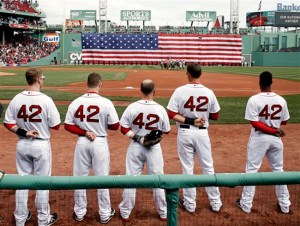
Baseball Honors Jackie Robinson and Victims in Boston

Rays Red Sox Baseball

This past Monday, Major League Baseball celebrated Jackie Robinson Day, an annual celebration to honor Jackie Robinson for being the first African American to play in the Major Leagues. Among other tributes, all players wore Robinson’s number 42.

Alongside the tributes for Jackie Robinson, there was also the fresh grief brought on by that afternoon’s bombings at the Boston Marathon in Boston, Massachusetts. The Associated Press did an interesting piece detailing the poignant intersection of Major League Baseball’s celebration of diversity and mourning the tragic events in Boston.

Of particular interest is Ben Revere of the Philadelphia Phillies. Revere made an incredible diving catch against the Cincinnati Reds while wearing a glove that bore the message “Pray for Boston.” Many other players wrote similar messages on gloves, hats, and cleats. But Ben Revere’s outstanding play was a cool moment on an important day for minorities in baseball, in the midst of a great tragedy.

Sometimes everything just comes together in one play.

When Guilt Drives Missions

“Missions exists because worship doesn’t.”[1]

These are the words of John Piper in his book Let the Nations Be Glad!: The Supremacy of God in Missions. The above quote is the essence of Piper’s thesis for the book—namely, that mission is not an end in itself. Rather, missions serves as the means to a greater end—the worldwide increase of worshipers for God—and therefore must  be undertaken in the spirit of pleasing God.

Indeed, the centrality of worship in missions is a thoroughly biblical idea. Consider, for example, Jesus’ words to his disciples just before he ascends to heaven:

And Jesus said to them, “All authority in heaven and on earth has been given to me. Go therefore and make disciples of all nations, baptizing them in the name of the Father and of the Son and of the Holy Spirit, teaching them to observe all that I have commanded you. And behold, I am with you to the end of the age.”

– Matthew 28:18-20 (ESV)

In this passage, famously known as the Great Commission, we see Jesus setting before the church its essential mission in the world. The church is to proclaim the gospel to those who don’t believe, train and equip disciples, and send them out to do the same thing in all parts of the world. But did you notice what Jesus says about himself? Two things:

  1. Jesus has all authority in heaven and on earth.
  2. Jesus is with his disciples to the end of the age.

Here Jesus bookends the imperative command with indicative statements about himself. And these two facts about Jesus are crucial because of how they inform and motive the church’s imperative calling to go into all the nations with the gospel message. Specifically, this reveals that what motivates Christians to take bold, radical, death-defying action in gospel mission is Jesus’ supreme authority and ever-present care. Indeed, Jesus’ divine authority and care are the very foundation of missions. Apart from knowing and cherishing Christ’s authority and care, the Christians would be left to their own devices in pursuit of their mission. And that would be a very bad thing.

It is clear in the above passage—as well as many others in the New Testament—that the ultimate fulfillment of the Great Commission depends entirely on God himself. However, it seems that many Christians—in their zeal for the church’s active pursuit of the Great Commission—are in danger of losing sight of God’s authority to accomplish it in his own power. One of the subtle ways in which God’s gospel power is often undermined is through guilt-inducing appeals for missions involvement.

If you have ever attended a church in which there is a high priority on global missions, then you have almost certainly seen this at work. During the church service, a visiting missionary is invited to come forward and speak to the church about his ministry in [insert closed country/region]. Right out of the gate, he bombards the congregation with a litany of breathtaking statistics: thousands of unreached people groups; billions of people dying every day without knowledge of Jesus Christ. And so on. Next, our missionary friend reminds the congregation of how blessed they are to have such embarrassingly-abundant access to the gospel: a church on every corner; hundreds of English-language Bible translations. And so on. He then proceeds to inform the congregation that they are awful Christians if they somehow fail to possess his same level of enthusiasm for forsaking the American dream in order to rescue the poor, benighted people of [insert closed country/region].

While this hypothetical scenario is somewhat hyperbolic on some points, I have seen variations of it in evangelical circles. When it does happen, everyone applauds our missionary friend for his sacrificial zeal for the global advance of the gospel. Quietly, however, most congregants walk away feeling chastised, discouraged, and downright guilty.

As with many things, sometimes our intentions and expectations do not match the reality. While we may think we are doing well to raise awareness and challenge fellow believers to action, the danger is that our message may end up bearing all the classic marks of a guilt trip. If we fail to be properly nuanced in our approach appeals for missions involvement, we may miss the high calling of joy-filled sacrifice while settling for guilt-driven duty.[2]

Sovereignty in Missions

One of the reasons guilt-driven missions is so dangerous is that it undermines the Christian’s robust confidence in the sovereignty of God in missions. As we mobilize Christians to take the gospel to all the nations of the earth, we do so with the core conviction that God himself has already secured salvation for his elect. Accordingly, Christians are reminded in Scripture that humans’ salvation through faith in Christ “does not depend on human will or exertion, but on God, who has mercy.” (Rom. 9:16) But that’s not all. Scripture also assures us that God’s normal means of bringing saving faith to his elect is through proclamation of the gospel. (Rom. 10:14) Living, breathing humans explain the gospel to other living, breathing humans who believe the gospel, turn from their sins, trust Christ, and receive the salvation of God.

Consequently, our understanding of God’s divine prerogative in conversion of sinners should be the driving force which motivates us to actively engage in the task of evangelizing the world. We courageously go to uncomfortable places and take great risks in order to proclaim the gospel message to people who do not want to hear it. Why? Because we know that God has secured the victory of his church in the missions enterprise. Though many will resist us, many others, whom God has chosen, will believe and be saved. We know that God will win, and so we faithfully pursue our mission.[3]

Some have wrongly suggested that an insistence on God’s sovereignty actually hinders Christians’ motivation to go and send on mission. This assumption is based on the idea that since God will only save those whom he has already chosen, he doesn’t need our help. In fact, we would only be getting in God’s way. As such, those who spend much time and energy on missions efforts are necessarily—or by implication—failing in their trust of God in his sovereignty. In reality, this could not be farther from the truth. God’s sovereignty, far from diminishing our zeal for missions involvement, actually fuels it! [4]

A Positive Example

I am thankful for the example of my own church, Capitol Hill Baptist Church. When our congregation hears about missions, we seldom hear numerical statistics. But whenever we do, there is great care given to make sure it is within the context of the reality of Christ’s finished work and his supreme authority. Our people are continually reminded that God himself has guaranteed the success of our mission if we remain faithful to his Word. And we have seen the emboldening effect that God’s sovereignty has wrought in our midst as members joyfully sacrifice much to reach our neighborhood, our city, and our world. We see the urgency of our missionary task, but we are not guilty and riddled with anxiety.

Of course, our church is far from perfect. But I am encouraged by God’s faithfulness, and I am convinced that God’s sovereignty, rather than guilt, is the greatest incentive to boldly take the gospel to all the nations.

__________________________________________

[1] John Piper, Let the Nations Be Glad!: The supremacy of God in missions (Grand Rapids: Baker, 2003), p. 17
[2] Let me to offer an example. David Platt, pastor of The Church at Brook Hills in Birmingham, Alabama, has done much good in calling Christians to sacrificially engage in the cause of global missions. He is a faithful gospel preacher, and I am thankful for his ministry. However, he often appeals to missions statistics in a manner that runs the risk, though unintentionally, of producing guilt and anxiety rather than hope. Still, Platt possesses a very important and powerful voice when it comes to missions, especially for young Christians and churches who do not yet have categories for biblical missiology and a commitment to going and sending in missions. For more of Platt’s thoughts, see his book, Radical (Multnomah, 2010).
[3] On this point, David Platt has spoken quite helpfully. See his message at Together for the Gospel 2012 entitled “Divine Sovereignty: The Fuel of Death-Defying Missions.” I think Platt earnestly believes this, and I wish his missions appeals more frequently included this nuance and explicit teaching on God’s sovereignty.
[4] For further reading on this, I recommend J.I. Packer’s book, Evangelism and the Sovereignty of God (IVP, 2012).