Jason Collins and Chris Broussard: Cultural Symbols in a Polarized Nation

I’ve always said that sports reflects culture. If there are certain worldviews and trends that seem pervasive in other sectors of mainstream society—government, media, pop culture—we will usually see them appear in sports as well. Right now, this theory is once again being validated.

On Monday, NBA basketball player Jason Collins announced publicly in a Sports Illustrated article that he considers himself gay. To many people, this was inevitable and long overdue—not that Collins himself would announce he is gay, but that someone currently playing professional sports would make this announcement. After all, the thinking goes, homosexuality is normal and natural. Surely, someone somewhere in a professional sports uniform is silently living as a homosexual, and eventually they will come out. We don’t know who it is, and we don’t really care. We just want someone to do it.

Well, the inevitable has finally happened. His name is Jason Collins.

Yet for all this, there was a second inevitability, dependent on the first. Just as there had to be a hero who had the “courage” to wear his homosexuality on his sleeve, there also had to be a villain who was despicable enough to publicly disagree with and even condemn the hero’s declaration. Well, we have our villain—Chris Broussard.

Following Collins’ announcement yesterday, ESPN basketball analyst Chris Broussard was asked on camera to comment. Why Broussard? Well, the obvious answer is that he is an NBA analyst and this is an NBA story. So it makes sense, right? But it quickly became clear that there was an even more specific reason ESPN chose Chris Broussard—and not, say, Jon Barry—to comment on Collins’ coming out.

You see, Chris Broussard has been very open about the fact that he is an evangelical Christian. That is, Broussard believes the gospel is uniquely true and that the Bible has complete authority. Most importantly, he has turned from willfully sinning and is trusting Jesus Christ alone for forgiveness and reconciliation with God.

So, when Jason Collins announced his homosexual lifestyle, ESPN saw an opportunity that was too good to pass up. On Monday’s edition of ESPN’s Outside The Lines, Broussard was asked to comment on Jason Collins’ claims to be both homosexual and a Christian. And here is how Broussard responded:

It is striking that when confronted with the question of homosexuality, the first words out of Broussard’s mouth are, “I’m a Christian.” He then provides a cogent summary of the Bible’s stance on homosexuality and unrepentant sin in general, noting particularly that the Bible expressly forbids people living in open sin and yet claiming to be Christian. As he makes the biblical case, Broussard registers his own assent to the Bible’s teaching. For Broussard, his stance on the matter is the Bible’s stance. For Christians, it can be no other way.

Not surprisingly, the backlash against Broussard has been sweeping and vitriolic. On Twitter, Broussard has been called almost every derogatory name one could imagine—many of them too heinous for me to repeat. Among his sports journalism peers, Broussard has been ostracized, with many people calling for him to be fined, suspended, or even fired. Indeed, the pervasive “tolerance” movement is once again driving its stake in the ground, just as it has done on so many other matters. And each time, the rhetoric is more extreme, more hateful—more intolerant to the minority who does not share the views of the majority. The irony is deep here.

But what is perhaps most interesting about the Collins-Broussard situation is the position of professional sports as an emblem of progress, or lack thereof, in society as a whole. What is true in sports must be true in society, and vice versa.

To be sure, there are many who desperately reject such a notion. Sports, it is thought by some, is one of the few spheres of public life in which one’s views on matters like race, religion, and sexuality are completely irrelevant. But we know better than this. For as the public debate over same-sex marriage has continued to heat up, there has been an increasing ground swell of people in sports clamoring for a brave soul who will finally break the “sexuality barrier” and become yet another powerful public symbol of America’s inevitable march toward complete normalization and integration of the homosexual lifestyle.

In order to finally achieve our ultimate aims, we need symbols—people, events, or objects that show us and those around us that our cause is authentic, legitimate, and achievable. On April 29, 2013, Jason Collins became that symbol in the realm of sports. The same-sex agenda already has its public symbols in the film, television, and music industries. The political sector has also provided its own share of high-profile symbols.

The only shoe that hadn’t dropped yet was sports. Advocates of same-sex marriage needed a public, high-profile symbol in one of the “big four” sports (i.e. football, basketball, baseball, hockey). And they got it. Make no mistake about it: Jason Collins now stands for something much bigger than himself. For many people in this country, he has become a living, breathing sign post that says same-sex attraction is normal, legitimate, and demanding of full, unqualified acceptance.

If Jason Collins is a symbol, then there is a flip side to that coin. Chris Broussard is also a symbol. When the news of Collins’ announcement became public, ESPN jumped at the opportunity to record a dissenting opinion from within the realm of sports. Why? Because every hero needs a villain to highlight the moral virtue of the hero’s cause. And that’s precisely what has happened. Broussard had barely finished articulating his position before hordes of people took to social media to register their moral outrage. For the mainstream pro-gay agenda, Broussard’s statement was a gift. It has served to further galvanize an ever-increasing consensus in favor of embracing the “tolerant” same-sex agenda.

For Christians, Broussard’s plight is a stark reminder of what we already know. That is, the era of Christian privilege in America has come to an end. We Christians have become a despised minority. It appears we are now entering a period of unprecedented marginalization of evangelicals in this nation. A clear line is being drawn right before our very eyes. More and more, the biblical worldview will be considered categorically incompatible with American ideals. As a result, there will no longer be a place in American public life for those of us who believe in the supreme authority of the Bible and the unique truth and saving power of the gospel.

Thankfully, God’s Word has prepared us to face such opposition:

Blessed are you when people hate you and when they exclude you and revile you and spurn you name as evil, on account of the Son of Man! Rejoice in that day, and leap for joy, for behold, your reward is great in heaven; for so their fathers did to the prophets.

– Luke 6:22-23

Though Jesus here was speaking directly to a crowd of Jews in the first century, the lesson applies to us today. Following Christ and opposing unrighteousness will get you hated. And when that happens, remember your heavenly reward and let that be cause for joy. God himself is our great reward, and he is worth all our allegiance, even when it costs us everything in this world.

I applaud Chris Broussard for taking a courageous stand for biblical truth in the midst of vehement opposition. His struggle is our struggle. He is a pronounced symbol for what we will now face every day in every place. Yes, he is a symbol. But what our mainstream society has intended to be a symbol of our defeat, is actually a symbol of our joy-filled suffering in anticipation of the ultimate vindication of our righteous cause.

This Week in Sports – 4/26/2013

Teddy Kremer and the Exploitation of Disabled Persons in Sports

This week, Sports Illustrated ran an interesting piece about how positive media responses toward feel-good stories in sports have sometimes led to athletes and teams exploiting persons with disabilities for the sake of garnering positive media attention. The focus of the article is last week’s heartwarming story about Teddy Kremer, a 30-year old man with Down syndrome who was chosen to be an honorary batboy for the Cincinnati Reds. Kremer reportedly asked Reds third baseman Todd Frazier to hit a home run for him. Frazier delivered, hitting a homer in the sixth inning to put the Reds up 11-1. Teddy bounded exuberantly toward home plate where he met Frazier and offered his congratulations in front of the home crowd. You can’t script a better story.

It’s true, we love tear-jerking stories like this, and we love organizations like the Cincinnati Reds for their acts of kindness. But is there a point where it becomes exploitative toward those with disabilities? Does our well-meaning intent to be charitable toward the less fortunate become a self-serving means of stroking our own ego and making the headlines? Perhaps. But this does not mean we should be hesitant to show kindness. Rather, we should be all the more thoughtful to ensure, as far as we are able, that our charitable gestures are both genuine and actually helpful. This is true in sports and all other areas of life.

Read the entire Sport Illustrated article here.

_______________________________________________________________________________

Ovie Nets a Beauty Against Ottawa

Watch this…

Alex Ovechkin, captain of the Washington Capitals, scored this ridiculous goal last night against the Ottawa Senators. Hockey fan or not, you’ve got to appreciate this kind of athleticism. Of course I am biased, but it’s good to see that Ovechkin is back to his old self.

________________________________________________________________________________

Top 10 Dunks of the NBA Playoffs – First Round

LeBron+James+Miami+Heat+v+Milwaukee+Bucks+kP9qsB4b9j_l

Full disclosure: I’m not a huge fan of the NBA. But I do love some good, violent dunks. Here are the NBA’s Top 10 dunks from the first round of the playoffs.

________________________________________________________________________________

Can the Nats Handle the Pressure?

Baseball season, as the saying goes, is a marathon, not a sprint. Still, with only 18 games in the books, I am already beginning to wonder if it is time to worry about the Washington Nationals.  After being swept by the Atlanta Braves and struggling to take just 1 of 3 games from the New York Mets, the Nats now own a very mediocre 10-8 record. Though expectations for this club are in the stratosphere, the Nats have limped through April with a multitude of unforeseen problems. Bad pitching, throwing errors, poor base-running. To make matters worse, Atlanta is having their best start to a season in about two decades.

Indeed, it appears that this Washington Nationals club is in some trouble. But is it time to panic? Not yet. At least, that’s what famed Washington Post sports columnist Tom Boswell seems to think. Earlier today, Boswell hosted a live chat during which he was asked whether or not he is worried about the Nats. Here is just a snippet of Boswell’s long, detailed response:

The Nats are playing poorly. Not atrociously. But they are lucky to be 10-8. Their actual play probably deserves 8-10 or worse. They are overanxious at the plate in tight games, like Werth swinging at a 3-0 pitcher’s pitch in the 8th on Sunday to kill a rally with a GIDP. They make base-running blunders or misjudgments, like Span getting throw out at 2nd by 8 feet on Sunday. Or they make errors on simple plays, like Desmond’s wide throw to 1st on Sunday. Or they have a lapse of concentration, like Harper’s embarrassing misplay of a routine single yesterday. Or they have an almost team-wide case of poor command of pitches, which sometimes means you’re just trying too hard.As is almost always the case when good teams play this way, it is NOT aa case of not trying hard enough or not caring enough. It is almost always the opposite — trying too hard, trying to “pick up the team” too much by doing too much yourself. It’s just April, for crying out loud. Just relax and play the game and enjoy. But that is far harder to do than to say.

I tweeted yesterday during the game that:  “the Nats must make 3-4-5 brutal mental mistakes or errors on easy plays in most of their games. 5 today. Pressing in April. Expectations rob joy.”

I got an e-mail after the game from a Nationals fan who said that she felt the team missed Michael Morse’s loose presence and felt it was obvious that the Nats were pressing, trying too hard, burdened by expectations — a team of analytical introverts who “need a clown” to help them relax.

I think that’s probably close to the case but not something that’s going to be as easily fixed as a few practical jokes or more chuckles on the bench. The Nats may miss Mark DeRosa as much as Morse.He was smart (Wharton degree), tough (Penn QB) and funny in a clubhouse way that seemed spontaneous but was also always part of setting team tone. It’s rare to see a player who doesn’t produce much, like DeRosa, who’s part of chemistry.

BUT the primary problem, IMO, is not the absence of Morse (or any one else). It’s the introduction of high expectations, criticism, judgment, Game 5. Some teams aren’t especially bothered by it. The Nats seem to be. You can’t know its importance until you see it play out. The reason that “expectations rob joy” is kind of a cliche is because it’s true. The Nats will have to learn to deal with it.

I like Boswell’s line of thinking, and it’s fairly similar to thoughts I’ve been having lately about the Nats. The Washington Nationals are victims of the extremely high expectations of baseball fans and and media in DC and beyond.

To be fair, high expectations are perfectly reasonable for a club as good as the Nats. The roster is talented, deep, and well-built. And considering that the front office somehow managed to improve in the offseason on a roster that already had such little downside, it only makes sense that many fans and media everywhere consider anything other than a World Series appearance to be a failure for this team. Indeed, one could argue that the Nationals, at least on paper, are unbeatable over the long haul.

Still, these are humans we’re talking about. Aside from the hours spent at the ballpark each day, these players have a lot of time on their hands. And to fill that time, they watch SportsCenter, they read the papers, and they listen to the sports talk radio stations. For anyone to assume otherwise would be somewhat naive. And as they tune into the media commentary, they are bombarded with the unrelenting pressure that comes with being at the top.

The Nats have a huge target painted on their backs, and they know it. All eyes in the National League are focused on them. There is no margin for error. Is this pressure, or at least the Nats’ perception of it, the reason for their struggles? I can’t say for sure. But it wouldn’t surprise me if this were a contributing factor so early in the season.

The more important question is, where will the Nationals go from here?

Only time will tell. That answer is simple and rather unsatisfactory for those who demand instant gratification. But to me, that’s the beauty of baseball. What appears to be a lost cause in April could turn out to be a gem by October. There are so many months ahead on the calendar, so much baseball yet to be played. Eighteen games, in the grand scheme, is of little account.

Still, as so many teams have discovered at summer’s end, a bad April could indeed come back to haunt you. As such, the Nationals need to get their act together—now. The good news is this: The Nationals are armed with arguably the deepest pitching rotation in baseball, a defense loaded with Gold Glove talent, multiple Silver Slugger winners, a reigning Rookie of the Year, and a manager with half a century of experience in the game.

Simply put, the Nats might look bad now, but they are definitely capable of turning things around quickly and in dramatic fashion. So, like Tom Boswell, I am certainly concerned about the Nats’ shaky start. But I am not worried. Not yet. Talk to me at the All-Star break.

__________________________________________________________________________________

Read Tom Boswell’s full article here.

Touchdown Pirates!

Here’s another heartwarming story from the world of college football. Last week, I posted about a 7 year-old cancer patient who was given a once-in-a-lifetime opportunity to run a 69-yard touchdown at the recent Nebraska Cornhuskers spring football game. Well, I hope you have another tissue box handy. As it turns out, another Division I-A college football program has decided to let a young cancer fighter take one to the house. This time, however, this honorable gesture was performed by Pirates of that most esteemed institution of higher learning— East Carolina University.

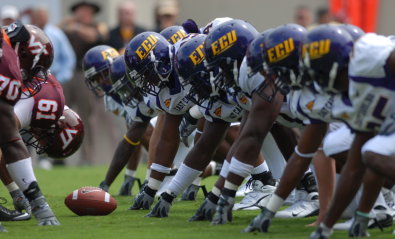
Last weekend, ECU held their annual Purple & Gold Game at Dowdy Ficklen Stadium on campus. Football-starved Pirate fans usually view the event as nothing more than an excuse to spend a nice spring day eating barbecue, drinking beer, and getting way too excited about an intrasquad scrimmage. But on the final play of the game, things took an emotional turn. Noah Roberts, an 8 year-old battling cancer, trotted out onto the field. Decked out in an ECU football jersey and helmet, Noah lined up in the tailback spot directly behind quarterback Shane Carden. Once the ball was snapped Carden handed it off to Noah, who sprinted 40 yards into the end zone.

Like Nebraska, this is another example of a big-time college football program making a classy move to give a brave kid a really cool experience. And for me, this one means even more because it’s my alma mater. There are many reasons why I am proud to be an alumnus of East Carolina University, and this most recent episode only adds to that long list.

This Week in Sports – 4/17/13

Welcome to the first of an installment I call “This Week in Sports.” Every Wednesday, I’ll point you to some of my favorite sports headlines including the good, the bad, and the ugly. But it won’t just be about scores and statistics. Instead, it will mostly consist of in-depth analysis and human interest stories. If you ever find something that you think might be of interest to me, feel free to contact me.

_______________________________________________________________________________

Kid With Cancer Makes a Touchdown Run

If you have a pulse, then this story has got to move you. At their recent spring football game, the Nebraska Cornhuskers ran a pretty crazy trick play. Lined up on their own 31 yard-line, the Huskers offense handed the ball to seven-year-old Jack Hoffman who ran it 69 yards for a touchdown. As he crossed the goal line, Jack was met by the entire Nebraska team who hoisted him on their shoulders.

Why is this a story? Jack Hoffman is currently battling inoperable brain cancer. At the request of his parents, Jack has become part of the Nebraska football family. And his touchdown run is just his latest feat in a Huskers uniform. I’m not a Nebraska football fan, and I know very little about the program. But I have tremendous respect for them for making this happen.

For more background on this story, check out ESPN’s piece here.

________________________________________________________________________________

Georgia Releases New Rap Video ‘Dawg Bite’

In other college football news, the Georgia Bulldogs celebrated their recent spring game with the release of their new rap video called ‘Dawg Bite.’ The video prominently features head coach Mark Richt’s son. Other notable cameos include Mark Richt himself and a portly Hank Williams Jr. lookalike.

As far as I’m concerned, producing rap videos for college football teams is not how I would ever choose to spend any of my time. Ever. But I do respect the right of others to engage in such activity, dubious as it may be. However, I would be remiss if I didn’t publicly register my outrage at the University of Georgia Athletics Department for allocating any of their resources to this. I mean, really? In case you’re wondering: yes, my wife is a Georgia alum and a filmmaker, but she was not involved with any stage of production of this video.

Here is one from my alma mater, East Carolina University: ‘My Heart Is Purple & Gold.’ Thankfully, there is no corresponding video, and I hope Pirate fans don’t get any ideas.

________________________________________________________________________________

Baseball Honors Jackie Robinson and Victims in Boston

Rays Red Sox Baseball

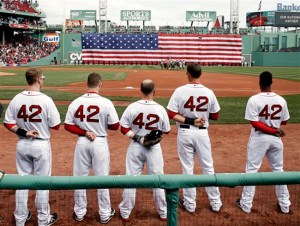
This past Monday, Major League Baseball celebrated Jackie Robinson Day, an annual celebration to honor Jackie Robinson for being the first African American to play in the Major Leagues. Among other tributes, all players wore Robinson’s number 42.

Alongside the tributes for Jackie Robinson, there was also the fresh grief brought on by that afternoon’s bombings at the Boston Marathon in Boston, Massachusetts. The Associated Press did an interesting piece detailing the poignant intersection of Major League Baseball’s celebration of diversity and mourning the tragic events in Boston.

Of particular interest is Ben Revere of the Philadelphia Phillies. Revere made an incredible diving catch against the Cincinnati Reds while wearing a glove that bore the message “Pray for Boston.” Many other players wrote similar messages on gloves, hats, and cleats. But Ben Revere’s outstanding play was a cool moment on an important day for minorities in baseball, in the midst of a great tragedy.

Sometimes everything just comes together in one play.

The Darker Side of Social Media

social-media

This month’s issue of ESPN the Magazine features a piece by Chris Jones exploring the impact of social media on those who struggle with depression. In his short yet penetrating article, Jones discusses the recent decision of professional tennis upstart Rebecca Marino to retire early due to her battle with depression. According to Jones, Marino cites not only the depression itself, but also the emotional wounds she suffered at the hands of cruel, unrelenting critics on Facebook and Twitter.

Jones reveals his own battle with depression and his sympathy for Marino’s plight:

“Unless the dark is the only place that feels safe. I’ve also battled depression, and I believe I know what or at least how Marino is thinking. I’ve thought a lot about giving up my job and vanishing — if I’m being honest, I’ve occasionally thought about vanishing in bigger ways too. When I’m in a good place, it seems insane to me that I’ve ever thought that way. My job is a dream job; my life is a dream life. But depression’s worst trick is its powers of distortion. It takes the good and makes it nearly invisible, and it takes the bad and amplifies it. People with depression also have long memories for hurt. Stings linger and layer.”

Jones then explains that his depression has, at times, been exacerbated by vocal critics, including one Twitter user who tweeted that he wished Jones would “eat a shotgun.”

This article is definitely worth a read, because it is a poignant commentary on the effect of the high-opinion, low-accountability, instant-sharing culture that has been created on the Internet, largely as a result of the prominence of social media interaction.

While social media platforms like Facebook and Twitter have made many positive and important contributions to different spheres of communication, commerce, and activism, they have also done their share of damage. Wherever people have the ability to instantly say whatever they want, with little or no accountability for what they say, there is both great opportunity and great peril.

For example, let’s consider Twitter for a moment. For me, one of the greatest benefits of Twitter is the ability to break news stories the moment they happen. In fact, many major news outlets have integrated Twitter into their normal communication strategies, encouraging consumers to tweet their questions, photos, ideas, and suggestions. It is clear that Twitter has revolutionized the way news media outlets do business.

At the same time, however, I cannot count how many “breaking news” tweets I have encountered over the past year that have turned out to be partially or entirely false. In such cases, we are left to grapple with the frustrating reminder that the First Amendment protects not only the distribution of information we find positive and helpful, but also that which is not so helpful, and sometimes even harmful.

Is Rebecca Marino a coward? Some would say so.  But I would suggest that she is the least cowardly of all in this sad narrative. While some would use technology to give full vent to their hatred and bitterness, Marino has had the courage to stare social media in the face–with all its commercial appeal and recreational allure–and disengage. Social media, Marino has decided, will not own her. It will not destroy her.

Contrary to what many of us–myself included–believe, social media is not an inevitable fact of life in a world saturated with instant e-communication. No, Marino has apparently decided that social media–and even her budding tennis career–can be discarded like everything else. Even in the digital age, there is more to life than staying connected.

Marino’s story is a reminder to us that real evil exists in the world, and it originates in the hearts of human beings. As much as we see and experience all the good contributions humans have made in this world–all the progress, all the philanthropy, all the peace initiatives, all the wonderful advances in medical and business technology–we are also faced with the reality that all of us, even the best of us, have within us a darker nature which compels us to do harm. And though we may insist on our good deeds and our honorable intentions–all of which may be true–none of us is immune from this corrupt nature the Bible calls sin.

Just as we see that human beings–made in the image of God and yet corrupt by nature–have a dual capacity for good and evil, we must also understand that the innovations of man likewise have a dual capacity to accomplish much good and much evil.

So what does this suggests about social media platforms? Are they evil in and of themselves? Are they to be avoided, or at least frowned upon, by those who wish to pursue righteousness? No, I do not believe that is the conclusion to be drawn here. Rather, we must grapple with the fact that the true source of evil exists within us. It comes from a heart that rejects the authority of the one true God in order to pursue our own selfish desires. Long before these heart desires reveal themselves in the form of vitriolic tweets or status updates, they grow up in our own hearts.

As such, social media is neither completely benevolent or malevolent. To the contrary, social media is a useful tool that can be abused. As such, the challenge for us is to exercise great care in how we use social media, recognizing that it can indeed become a grotesque platform for our sin.

This concept is not at all foreign to biblical Christianity. In fact, it is foundational to properly understanding the spiritual state of mankind in this world. Jesus himself affirms this in his teaching about what defiles a person:

“There is nothing outside a person that by going into him can defile him, but the things that come out of a person are what defile him…What comes out of a person is what defiles him. For from within, out of the heart of man, come evil thoughts, sexual immorality, theft, murder, adultery, coveting, wickedness, deceit, sensuality, envy, slander, pride, foolishness. All these evil things come from within, and they defile a person.”

– Mark 7: 15;20-23

Since Jesus is here offering a rebuttal for a false hope of righteousness from ritual purity, that is the primary point of the passage. But it also points to the broader principle that sin and righteousness are always matters of the heart, not merely physical things. Moreover, this world is filled with many things which, being neither inherently good or evil, require us to exercise much wisdom in our use of them.

In short, social media is not the problem. We are the problem.  However, social media–as Rebecca Marino can attest– is a dangerous weapon in the hands of sinners. As such, we cannot afford to partake of social media without reflecting on our own hearts. On a practical level, this could mean something very different for you than for me. But faithfulness to God–and simple human decency–demands that we handle social media with the utmost of care.

The Comeback Caps

Don’t call it a comeback! Actually, yeah, go ahead and call it a comeback—an impressive one, at that.

On Tuesday night, the Washington Capitals overcame a three-goal deficit to defeat the red-hot Boston Bruins in overtime. It was quite a treat for the rabid home crowd at Verizon Center in DC, and it’s sure to be remembered as a signature moment if the Caps make the playoffs.

It was a significant achievement for the Capitals, who trailed the Bruins 3-0 at the the end of the first period—a situation that has seemed all too familiar for this team as they have struggled through a sluggish start to this shortened season. And yet, to everyone’s surprise, the Caps fought back in the remaining 40 minutes of regulation to post three unanswered goals.

The Caps’ stunning comeback was punctuated by Eric Fehr’s spectacular game-winning overtime goal. Check it out:

fehr-goal

And here is the radio call by John Walton:

It appears there are yet signs of life for this Capitals club. It will still be an uphill battle to earn a playoff spot. But if the Caps continue to play the way they have in the past couple of games, there is reason for optimism.

ECU Pirates Through the Tunnel

If you have never been to an East Carolina University football game at Dowdy Ficklen Stadium, you have truly been missing out on one of the most fun, most exciting college football atmospheres in the country—especially the moment when the Pirates take the field before opening kickoff.

Well, if you have never seen it—heck, even if you have seen it—I’ve got something for you to check out. A friend of mine recently sent me a very cool video of the ECU football team’s journey from the locker room, through the tunnel, and onto the field for a recent home game against Marshall. What makes this video so interesting is that it is shot from first-person perspective using a camera mounted on ECU punter Trent Tignor’s helmet.

Check it out:

Pretty cool, huh? If you listen carefully, you can hear “Purple Haze” playing as the Pirates enter the tunnel.

Sure, I will admit that I am biased since I am an East Carolina alum and a rabid fan of Pirate football. But you’ve got to agree that this is fun to watch. For me, it just provides more incentive to try and make the trip down to Greenville for some games next season.

GO PIRATES!

ECU Football: 2012 Preview

Well, it’s about that time again…the most wonderful time of the year. Summer is winding down, and Labor Day is right around the corner. And with it comes the long-awaited return of one of America’s most beloved institutions—college football.

Besides the excitement of watching the nation’s top programs compete week after week, what gets me most excited about college football season is cheering for my favorite team—the Pirates of East Carolina University. ECU is my alma mater, and I cherish my glory days of tailgating, face-painting, and yelling “Arrrgh!” along with fellow die-hards in the student section. As always, I’m approaching this upcoming season with excitement and optimism that my Pirates will do well. But 2012 figures to be a challenging Fall for the Purple and Gold.

As usual, East Carolina faces one of the toughest non-conference schedules in the FBS division. Besides opening the season with FCS powerhouse Appalachian State (5), ECU is also set to face South Carolina (9), North Carolina, and Navy. Still, the Pirates have as good an opportunity as any at contending for the Conference USA title and securing a bowl bid. If they want to do so, however, the Pirates will have a lot to overcome.

Here are some things ECU will need to focus on this season:

OFFENSE

  • Run the ball. If the Pirates want to be successful in 2012, they will need to establish a solid, consistent ground game. Unfortunately, it remains questionable whether ECU has the necessary backfield talent to pull this off. Last season, the Pirates averaged a pathetic 109.1 rushing yards per game. Torrence Hunt was ECU’s leading rusher with a mere 489 yards for the entire season. To make matters worse, the offensive line is full of question marks. This year, the Pirates will need a strong effort from the big guys up front. In addition, senior Reggie Bullock cold really help things a lot by stepping up to supplement the rushing attack.
  • Seriously—run the football. Enough with the pass-all-the-time gimmick. It’s time to grow up. If the Pirates are going to seriously compete against teams in the SEC and the ACC, 109 rushing yards per game simply won’t get it done.This year, the Pirates could rely heavily on the run game in week 2 against South Carolina whom USA Today ranks 2nd in the country in passing defense. (The Gamecocks rank a measly 45th in rushing defense.) Furthermore, ECU could really capitalize on C-USA opponents who are more acclimated to seeing spread offenses and multi-quarterback systems. If the Pirates can mix things up with a couple traditional running formations, that could go a long way toward matching up well against some tough defenses. And it could also help set up some effective play-action looks.
  • Pass effectively. Two days ago, head coach Ruffin McNeill finally named Rio Johnson as the starting quarterback. Now that the infamous four-way quarterback controversy has been settled, ECU can get down to business and focus on establishing an effective passing plan. Offensive coordinator Lincoln Riley proved last season that he is capable of drawing up a formidable passing attack. And the Pirates boast a corps of talented receivers like Justin Hardy and Andrew Bodenheimer. Whether Rio Johnson can consistently get the ball to them remains to be seen. The key will be to throw the ball down field. Screen passes will only take this offensive unit so far, especially since they no longer have the breakaway speed of a Chris Johnson.

DEFENSE

  • Keep the score low. Okay, this is obvious. The job of any defense is to keep the other team off the scoreboard as much as possible. But this is even more important in a league like Conference USA where spread offenses run rampant and defense is an afterthought. Given the high-scoring tendencies of C-USA, the Pirates will do well to focus on keeping opponents out of the end-zone. Fortunately, the Pirates have shown signs of steady improvement on defense. After surrendering a jaw-dropping 44 points per game in 2010, the Pirates’ defense allowed only 32.3 points per game last season. That’s still not good, but it’s better. And if the Pirates can keep improving defensively, they might be able to steal a couple extra wins in 2012.
  • Be aggressive. As ECU looks to improve defensively, aggressive is the operative word. Look for defensive coordinator Brian Mitchell to mix in lots of different blitz packages, especially against some of their more pass-happy C-USA opponents. This should come natural to the Pirates’ talented front seven, led by linebacker Jeremy Grove and defensive end Matt Milner. In the secondary, the Pirates have suffered some key losses. Still, safety Damon Magazu has been impressive, and he should prove to be an effective leader for the Pirates secondary this season. If the Pirates can play aggressively on defense, they should be able to create some turnovers and shift momentum at key moments.

PREDICTION

7-5 Overall (5-3 C-USA). This will likely be another challenging, frustrating season of rebuilding for East Carolina. But I think they have what it takes to make some measured progress and sneak into a bowl game. The first four games will be tough, but should prepare the Pirates to compete well within Conference USA. While the Pirates may upset North Carolina in week four, that home opener against Appalachian State could be a trap game. All things considered, six or seven wins seems about right.

Of course, I hope I’m wrong. I hope the Pirates go undefeated! (I can dream, can’t I?) This will be an interesting and important season for ECU football. If the Pirates miss bowl eligibility this season, head coach Ruffin McNeill might be looking for a new job. But let’s not talk about that right now. Let’s just hoist the colors and cheer for Old E.C.

Here’s to a great season, football fans!

GO PIRATES! ARRRGH!!!

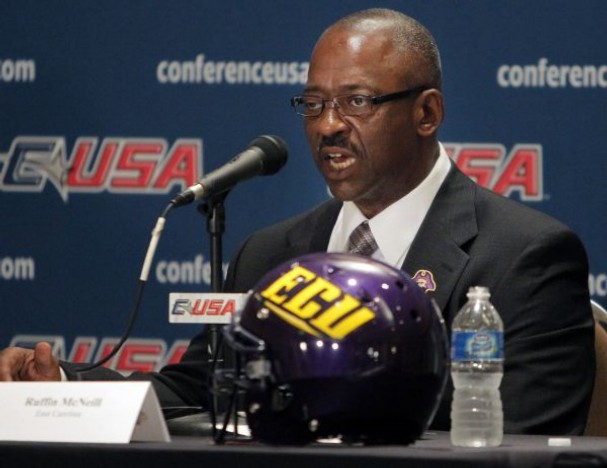
C-USA Media Day: Interview with East Carolina Head Coach Ruffin McNeill

In just a few short weeks, college football season will be upon us. As an East Carolina alum, I am excited about cheering on my beloved Pirates. Check out this video interview from the recent Conference USA Media Day. Head coach Ruffin McNeill and junior linebacker Damon Magazu provide their perspective on this year’s squad and a preview of the season.  Watch the video here.