This Week in Sports – 4/26/2013

Teddy Kremer and the Exploitation of Disabled Persons in Sports

This week, Sports Illustrated ran an interesting piece about how positive media responses toward feel-good stories in sports have sometimes led to athletes and teams exploiting persons with disabilities for the sake of garnering positive media attention. The focus of the article is last week’s heartwarming story about Teddy Kremer, a 30-year old man with Down syndrome who was chosen to be an honorary batboy for the Cincinnati Reds. Kremer reportedly asked Reds third baseman Todd Frazier to hit a home run for him. Frazier delivered, hitting a homer in the sixth inning to put the Reds up 11-1. Teddy bounded exuberantly toward home plate where he met Frazier and offered his congratulations in front of the home crowd. You can’t script a better story.

It’s true, we love tear-jerking stories like this, and we love organizations like the Cincinnati Reds for their acts of kindness. But is there a point where it becomes exploitative toward those with disabilities? Does our well-meaning intent to be charitable toward the less fortunate become a self-serving means of stroking our own ego and making the headlines? Perhaps. But this does not mean we should be hesitant to show kindness. Rather, we should be all the more thoughtful to ensure, as far as we are able, that our charitable gestures are both genuine and actually helpful. This is true in sports and all other areas of life.

Read the entire Sport Illustrated article here.

_______________________________________________________________________________

Ovie Nets a Beauty Against Ottawa

Watch this…

Alex Ovechkin, captain of the Washington Capitals, scored this ridiculous goal last night against the Ottawa Senators. Hockey fan or not, you’ve got to appreciate this kind of athleticism. Of course I am biased, but it’s good to see that Ovechkin is back to his old self.

________________________________________________________________________________

Top 10 Dunks of the NBA Playoffs – First Round

LeBron+James+Miami+Heat+v+Milwaukee+Bucks+kP9qsB4b9j_l

Full disclosure: I’m not a huge fan of the NBA. But I do love some good, violent dunks. Here are the NBA’s Top 10 dunks from the first round of the playoffs.

________________________________________________________________________________

Can the Nats Handle the Pressure?

Baseball season, as the saying goes, is a marathon, not a sprint. Still, with only 18 games in the books, I am already beginning to wonder if it is time to worry about the Washington Nationals.  After being swept by the Atlanta Braves and struggling to take just 1 of 3 games from the New York Mets, the Nats now own a very mediocre 10-8 record. Though expectations for this club are in the stratosphere, the Nats have limped through April with a multitude of unforeseen problems. Bad pitching, throwing errors, poor base-running. To make matters worse, Atlanta is having their best start to a season in about two decades.

Indeed, it appears that this Washington Nationals club is in some trouble. But is it time to panic? Not yet. At least, that’s what famed Washington Post sports columnist Tom Boswell seems to think. Earlier today, Boswell hosted a live chat during which he was asked whether or not he is worried about the Nats. Here is just a snippet of Boswell’s long, detailed response:

The Nats are playing poorly. Not atrociously. But they are lucky to be 10-8. Their actual play probably deserves 8-10 or worse. They are overanxious at the plate in tight games, like Werth swinging at a 3-0 pitcher’s pitch in the 8th on Sunday to kill a rally with a GIDP. They make base-running blunders or misjudgments, like Span getting throw out at 2nd by 8 feet on Sunday. Or they make errors on simple plays, like Desmond’s wide throw to 1st on Sunday. Or they have a lapse of concentration, like Harper’s embarrassing misplay of a routine single yesterday. Or they have an almost team-wide case of poor command of pitches, which sometimes means you’re just trying too hard.As is almost always the case when good teams play this way, it is NOT aa case of not trying hard enough or not caring enough. It is almost always the opposite — trying too hard, trying to “pick up the team” too much by doing too much yourself. It’s just April, for crying out loud. Just relax and play the game and enjoy. But that is far harder to do than to say.

I tweeted yesterday during the game that:  “the Nats must make 3-4-5 brutal mental mistakes or errors on easy plays in most of their games. 5 today. Pressing in April. Expectations rob joy.”

I got an e-mail after the game from a Nationals fan who said that she felt the team missed Michael Morse’s loose presence and felt it was obvious that the Nats were pressing, trying too hard, burdened by expectations — a team of analytical introverts who “need a clown” to help them relax.

I think that’s probably close to the case but not something that’s going to be as easily fixed as a few practical jokes or more chuckles on the bench. The Nats may miss Mark DeRosa as much as Morse.He was smart (Wharton degree), tough (Penn QB) and funny in a clubhouse way that seemed spontaneous but was also always part of setting team tone. It’s rare to see a player who doesn’t produce much, like DeRosa, who’s part of chemistry.

BUT the primary problem, IMO, is not the absence of Morse (or any one else). It’s the introduction of high expectations, criticism, judgment, Game 5. Some teams aren’t especially bothered by it. The Nats seem to be. You can’t know its importance until you see it play out. The reason that “expectations rob joy” is kind of a cliche is because it’s true. The Nats will have to learn to deal with it.

I like Boswell’s line of thinking, and it’s fairly similar to thoughts I’ve been having lately about the Nats. The Washington Nationals are victims of the extremely high expectations of baseball fans and and media in DC and beyond.

To be fair, high expectations are perfectly reasonable for a club as good as the Nats. The roster is talented, deep, and well-built. And considering that the front office somehow managed to improve in the offseason on a roster that already had such little downside, it only makes sense that many fans and media everywhere consider anything other than a World Series appearance to be a failure for this team. Indeed, one could argue that the Nationals, at least on paper, are unbeatable over the long haul.

Still, these are humans we’re talking about. Aside from the hours spent at the ballpark each day, these players have a lot of time on their hands. And to fill that time, they watch SportsCenter, they read the papers, and they listen to the sports talk radio stations. For anyone to assume otherwise would be somewhat naive. And as they tune into the media commentary, they are bombarded with the unrelenting pressure that comes with being at the top.

The Nats have a huge target painted on their backs, and they know it. All eyes in the National League are focused on them. There is no margin for error. Is this pressure, or at least the Nats’ perception of it, the reason for their struggles? I can’t say for sure. But it wouldn’t surprise me if this were a contributing factor so early in the season.

The more important question is, where will the Nationals go from here?

Only time will tell. That answer is simple and rather unsatisfactory for those who demand instant gratification. But to me, that’s the beauty of baseball. What appears to be a lost cause in April could turn out to be a gem by October. There are so many months ahead on the calendar, so much baseball yet to be played. Eighteen games, in the grand scheme, is of little account.

Still, as so many teams have discovered at summer’s end, a bad April could indeed come back to haunt you. As such, the Nationals need to get their act together—now. The good news is this: The Nationals are armed with arguably the deepest pitching rotation in baseball, a defense loaded with Gold Glove talent, multiple Silver Slugger winners, a reigning Rookie of the Year, and a manager with half a century of experience in the game.

Simply put, the Nats might look bad now, but they are definitely capable of turning things around quickly and in dramatic fashion. So, like Tom Boswell, I am certainly concerned about the Nats’ shaky start. But I am not worried. Not yet. Talk to me at the All-Star break.

__________________________________________________________________________________

Read Tom Boswell’s full article here.

Touchdown Pirates!

Here’s another heartwarming story from the world of college football. Last week, I posted about a 7 year-old cancer patient who was given a once-in-a-lifetime opportunity to run a 69-yard touchdown at the recent Nebraska Cornhuskers spring football game. Well, I hope you have another tissue box handy. As it turns out, another Division I-A college football program has decided to let a young cancer fighter take one to the house. This time, however, this honorable gesture was performed by Pirates of that most esteemed institution of higher learning— East Carolina University.

Last weekend, ECU held their annual Purple & Gold Game at Dowdy Ficklen Stadium on campus. Football-starved Pirate fans usually view the event as nothing more than an excuse to spend a nice spring day eating barbecue, drinking beer, and getting way too excited about an intrasquad scrimmage. But on the final play of the game, things took an emotional turn. Noah Roberts, an 8 year-old battling cancer, trotted out onto the field. Decked out in an ECU football jersey and helmet, Noah lined up in the tailback spot directly behind quarterback Shane Carden. Once the ball was snapped Carden handed it off to Noah, who sprinted 40 yards into the end zone.

Like Nebraska, this is another example of a big-time college football program making a classy move to give a brave kid a really cool experience. And for me, this one means even more because it’s my alma mater. There are many reasons why I am proud to be an alumnus of East Carolina University, and this most recent episode only adds to that long list.

Honoring the Legacy of John Piper

After serving for 33 years as pastor of Bethlehem Baptist Church in Minneapolis, Minnesota, John Piper is retiring from the pulpit to focus his attention on writing, speaking, and providing leadership for Desiring God Ministries.

In light of his retirement from the pastorate, Bethlehem Baptist has teamed up with Desiring God Ministries and The Bethlehem Institute to produce video tribute to John Piper. This moving, 19-minute video features testimonies from various men and women who have worked alongside John Piper and have been greatly impacted by his ministry.

My wife Suzanne edited the video. She and the team at Citygate Films produced this video in its entirety, and I consider myself blessed to have such an up-close view of their work on this and many other gospel-centered film projects for Desiring God Ministries.

As I watched the video myself, I couldn’t help but reflect on the ways John Piper’s writing and preaching have profoundly impacted me. When I became a Christian in 2003 during my freshman year in college, Piper’s book Don’t Waste Your Life was the first book I read. I didn’t know who John Piper was back then, but a friend gave me the book and encouraged me to read it. And I did read it—in one sitting. I couldn’t put it down. Piper’s radical vision of joyfully risking all make much of Christ in all of life completely revolutionized my thinking. That little book set my life on an irreversible course toward an ever-deepening sense of God’s calling on my life to make my life mean something for his glory.

It didn’t stop there. Piper has taught me, in his writing and preaching, that a deep, thoughtful, blood-earnest ferocity for the things of God is something to be sought after. He has taught me that true Christian joy has a distinct seriousness to it, and everything in life must serve the single-minded pursuit of that joy. Whether I am silent or shouting, laughing or weeping, giving or receiving, supreme happiness in God is the aim.

Piper has modeled for me a painstaking precision in reading and interpreting the Word of God. Yes, specific words are used for a reason. Sentence construction is by no means coincidental. Some Bible translations are actually better than others. These lessons were monumental for me in the formative years of my faith, and they still shape my approach to God’s Word as I now aspire to serve as a pastor myself.

To some, this may seem strange to offer such sustained praise for another human being. Indeed, some may think it doesn’t seem very Christ-exalting, but rather man-exalting. After all, isn’t John Piper simply a human instrument of God’s awesome grace. Yes! And that is precisely why I am so grateful for John Piper’s life and ministry. You see, the truth is that John Piper is just a man like me—a weak, helpless sinner who has been saved by God’s amazing mercy in Jesus Christ. And apart from Christ, John Piper’s ministry would never exist. But by God’s grace, John Piper stands as a shining example of God’s faithfulness to make his Name great in all the nations by using even those who are weakest and least significant by worldly standards.

Time and time again, John Piper has boldly proclaimed what he knows to be folly to those who are perishing, because it is wisdom and power to those who are being saved. In all my life, I can only think of a handful of men who have so boldly, consistently, graciously, and powerfully stood for gospel truth in this world. Every generation has their prophetic voices, and surely John Piper has been one for our generation.

I have never met John Piper. I hope to someday. I have a million questions for him! But even if I never meet the man face-to-face in this life, I am compelled to voice my love and appreciation for him. He has done much to point me to Christ, and I trust many others could say the same.

May God continue to bless John Piper’s ministry as he moves into a new role at Desiring God.

This Week in Sports – 4/17/13

Welcome to the first of an installment I call “This Week in Sports.” Every Wednesday, I’ll point you to some of my favorite sports headlines including the good, the bad, and the ugly. But it won’t just be about scores and statistics. Instead, it will mostly consist of in-depth analysis and human interest stories. If you ever find something that you think might be of interest to me, feel free to contact me.

_______________________________________________________________________________

Kid With Cancer Makes a Touchdown Run

If you have a pulse, then this story has got to move you. At their recent spring football game, the Nebraska Cornhuskers ran a pretty crazy trick play. Lined up on their own 31 yard-line, the Huskers offense handed the ball to seven-year-old Jack Hoffman who ran it 69 yards for a touchdown. As he crossed the goal line, Jack was met by the entire Nebraska team who hoisted him on their shoulders.

Why is this a story? Jack Hoffman is currently battling inoperable brain cancer. At the request of his parents, Jack has become part of the Nebraska football family. And his touchdown run is just his latest feat in a Huskers uniform. I’m not a Nebraska football fan, and I know very little about the program. But I have tremendous respect for them for making this happen.

For more background on this story, check out ESPN’s piece here.

________________________________________________________________________________

Georgia Releases New Rap Video ‘Dawg Bite’

In other college football news, the Georgia Bulldogs celebrated their recent spring game with the release of their new rap video called ‘Dawg Bite.’ The video prominently features head coach Mark Richt’s son. Other notable cameos include Mark Richt himself and a portly Hank Williams Jr. lookalike.

As far as I’m concerned, producing rap videos for college football teams is not how I would ever choose to spend any of my time. Ever. But I do respect the right of others to engage in such activity, dubious as it may be. However, I would be remiss if I didn’t publicly register my outrage at the University of Georgia Athletics Department for allocating any of their resources to this. I mean, really? In case you’re wondering: yes, my wife is a Georgia alum and a filmmaker, but she was not involved with any stage of production of this video.

Here is one from my alma mater, East Carolina University: ‘My Heart Is Purple & Gold.’ Thankfully, there is no corresponding video, and I hope Pirate fans don’t get any ideas.

________________________________________________________________________________

Baseball Honors Jackie Robinson and Victims in Boston

Rays Red Sox Baseball

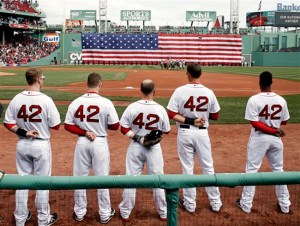
This past Monday, Major League Baseball celebrated Jackie Robinson Day, an annual celebration to honor Jackie Robinson for being the first African American to play in the Major Leagues. Among other tributes, all players wore Robinson’s number 42.

Alongside the tributes for Jackie Robinson, there was also the fresh grief brought on by that afternoon’s bombings at the Boston Marathon in Boston, Massachusetts. The Associated Press did an interesting piece detailing the poignant intersection of Major League Baseball’s celebration of diversity and mourning the tragic events in Boston.

Of particular interest is Ben Revere of the Philadelphia Phillies. Revere made an incredible diving catch against the Cincinnati Reds while wearing a glove that bore the message “Pray for Boston.” Many other players wrote similar messages on gloves, hats, and cleats. But Ben Revere’s outstanding play was a cool moment on an important day for minorities in baseball, in the midst of a great tragedy.

Sometimes everything just comes together in one play.

When Guilt Drives Missions

“Missions exists because worship doesn’t.”[1]

These are the words of John Piper in his book Let the Nations Be Glad!: The Supremacy of God in Missions. The above quote is the essence of Piper’s thesis for the book—namely, that mission is not an end in itself. Rather, missions serves as the means to a greater end—the worldwide increase of worshipers for God—and therefore must  be undertaken in the spirit of pleasing God.

Indeed, the centrality of worship in missions is a thoroughly biblical idea. Consider, for example, Jesus’ words to his disciples just before he ascends to heaven:

And Jesus said to them, “All authority in heaven and on earth has been given to me. Go therefore and make disciples of all nations, baptizing them in the name of the Father and of the Son and of the Holy Spirit, teaching them to observe all that I have commanded you. And behold, I am with you to the end of the age.”

– Matthew 28:18-20 (ESV)

In this passage, famously known as the Great Commission, we see Jesus setting before the church its essential mission in the world. The church is to proclaim the gospel to those who don’t believe, train and equip disciples, and send them out to do the same thing in all parts of the world. But did you notice what Jesus says about himself? Two things:

  1. Jesus has all authority in heaven and on earth.
  2. Jesus is with his disciples to the end of the age.

Here Jesus bookends the imperative command with indicative statements about himself. And these two facts about Jesus are crucial because of how they inform and motive the church’s imperative calling to go into all the nations with the gospel message. Specifically, this reveals that what motivates Christians to take bold, radical, death-defying action in gospel mission is Jesus’ supreme authority and ever-present care. Indeed, Jesus’ divine authority and care are the very foundation of missions. Apart from knowing and cherishing Christ’s authority and care, the Christians would be left to their own devices in pursuit of their mission. And that would be a very bad thing.

It is clear in the above passage—as well as many others in the New Testament—that the ultimate fulfillment of the Great Commission depends entirely on God himself. However, it seems that many Christians—in their zeal for the church’s active pursuit of the Great Commission—are in danger of losing sight of God’s authority to accomplish it in his own power. One of the subtle ways in which God’s gospel power is often undermined is through guilt-inducing appeals for missions involvement.

If you have ever attended a church in which there is a high priority on global missions, then you have almost certainly seen this at work. During the church service, a visiting missionary is invited to come forward and speak to the church about his ministry in [insert closed country/region]. Right out of the gate, he bombards the congregation with a litany of breathtaking statistics: thousands of unreached people groups; billions of people dying every day without knowledge of Jesus Christ. And so on. Next, our missionary friend reminds the congregation of how blessed they are to have such embarrassingly-abundant access to the gospel: a church on every corner; hundreds of English-language Bible translations. And so on. He then proceeds to inform the congregation that they are awful Christians if they somehow fail to possess his same level of enthusiasm for forsaking the American dream in order to rescue the poor, benighted people of [insert closed country/region].

While this hypothetical scenario is somewhat hyperbolic on some points, I have seen variations of it in evangelical circles. When it does happen, everyone applauds our missionary friend for his sacrificial zeal for the global advance of the gospel. Quietly, however, most congregants walk away feeling chastised, discouraged, and downright guilty.

As with many things, sometimes our intentions and expectations do not match the reality. While we may think we are doing well to raise awareness and challenge fellow believers to action, the danger is that our message may end up bearing all the classic marks of a guilt trip. If we fail to be properly nuanced in our approach appeals for missions involvement, we may miss the high calling of joy-filled sacrifice while settling for guilt-driven duty.[2]

Sovereignty in Missions

One of the reasons guilt-driven missions is so dangerous is that it undermines the Christian’s robust confidence in the sovereignty of God in missions. As we mobilize Christians to take the gospel to all the nations of the earth, we do so with the core conviction that God himself has already secured salvation for his elect. Accordingly, Christians are reminded in Scripture that humans’ salvation through faith in Christ “does not depend on human will or exertion, but on God, who has mercy.” (Rom. 9:16) But that’s not all. Scripture also assures us that God’s normal means of bringing saving faith to his elect is through proclamation of the gospel. (Rom. 10:14) Living, breathing humans explain the gospel to other living, breathing humans who believe the gospel, turn from their sins, trust Christ, and receive the salvation of God.

Consequently, our understanding of God’s divine prerogative in conversion of sinners should be the driving force which motivates us to actively engage in the task of evangelizing the world. We courageously go to uncomfortable places and take great risks in order to proclaim the gospel message to people who do not want to hear it. Why? Because we know that God has secured the victory of his church in the missions enterprise. Though many will resist us, many others, whom God has chosen, will believe and be saved. We know that God will win, and so we faithfully pursue our mission.[3]

Some have wrongly suggested that an insistence on God’s sovereignty actually hinders Christians’ motivation to go and send on mission. This assumption is based on the idea that since God will only save those whom he has already chosen, he doesn’t need our help. In fact, we would only be getting in God’s way. As such, those who spend much time and energy on missions efforts are necessarily—or by implication—failing in their trust of God in his sovereignty. In reality, this could not be farther from the truth. God’s sovereignty, far from diminishing our zeal for missions involvement, actually fuels it! [4]

A Positive Example

I am thankful for the example of my own church, Capitol Hill Baptist Church. When our congregation hears about missions, we seldom hear numerical statistics. But whenever we do, there is great care given to make sure it is within the context of the reality of Christ’s finished work and his supreme authority. Our people are continually reminded that God himself has guaranteed the success of our mission if we remain faithful to his Word. And we have seen the emboldening effect that God’s sovereignty has wrought in our midst as members joyfully sacrifice much to reach our neighborhood, our city, and our world. We see the urgency of our missionary task, but we are not guilty and riddled with anxiety.

Of course, our church is far from perfect. But I am encouraged by God’s faithfulness, and I am convinced that God’s sovereignty, rather than guilt, is the greatest incentive to boldly take the gospel to all the nations.

__________________________________________

[1] John Piper, Let the Nations Be Glad!: The supremacy of God in missions (Grand Rapids: Baker, 2003), p. 17
[2] Let me to offer an example. David Platt, pastor of The Church at Brook Hills in Birmingham, Alabama, has done much good in calling Christians to sacrificially engage in the cause of global missions. He is a faithful gospel preacher, and I am thankful for his ministry. However, he often appeals to missions statistics in a manner that runs the risk, though unintentionally, of producing guilt and anxiety rather than hope. Still, Platt possesses a very important and powerful voice when it comes to missions, especially for young Christians and churches who do not yet have categories for biblical missiology and a commitment to going and sending in missions. For more of Platt’s thoughts, see his book, Radical (Multnomah, 2010).
[3] On this point, David Platt has spoken quite helpfully. See his message at Together for the Gospel 2012 entitled “Divine Sovereignty: The Fuel of Death-Defying Missions.” I think Platt earnestly believes this, and I wish his missions appeals more frequently included this nuance and explicit teaching on God’s sovereignty.
[4] For further reading on this, I recommend J.I. Packer’s book, Evangelism and the Sovereignty of God (IVP, 2012).

Resources on Same-Sex Marriage

I know. I’m sorry.

When you saw this post come up on your news feed, you probably thought, “Oh no! Not another preachy manifesto on the moral implications of same-sex marriage. Why does everyone with Internet access suddenly think they are the second coming of Frederick Douglass?”

Or perhaps you’re thinking that if you have to see one more red equals sign on Facebook, you might just go ahead and strangle somebody.

If either of the above categories represents how you’re feeling, that’s totally fine. I get it. I’m just about there myself, to be honest. Here’s the good news: I’m not going to add my own two cents—at least not right now. If you are interested in what I have to say, I have already written some of my own thoughts on same-sex marriage here and here.

Though these issues regarding same-sex marriage are important for Christians to understand and wrestle with, there also comes a point where it hits you all at once and you just need a break. So feel free to check out of the discussion for a little bit.

Put on a movie. Go for a walk. Read a book. Learn a language. Live your life and be happy! You don’t need to stay glued to your computer or television screen, worrying yourself silly about what the U.S. Supreme Court will decide. It’s okay to pull the plug for a while. But make sure you come back at some point. You can’t ignore this stuff forever.

For those who are interested in staying engaged right now, allow me to point you to some good resources for helping Christians think well about how to approach the same-sex marriage discussion with compassion, intelligence, and biblical faithfulness. I have read all of these articles this week and have found them helpful in my own thinking and discussions with others. Both of these articles deal with the causes and effects of professed Christians supporting gay marriage. Here they are:


Why the Arguments for Gay Marriage are Persuasive

Kevin DeYoung discusses five reasons why the arguments in favor of same-sex marriage are persuasive for many Americans, including young evangelicals.


When Did Idolatry Become Compatible with Christianity?

Joe Carter considers explores the current trend of evangelicals supporting same-sex marriage due to an idolatrous allegiance to the American ideal of civil liberty. Essentially, Carter argues that some Christians are in danger of abandoning biblical faithfulness for the sake of protecting the American way.


Note: If you are not familiar with The Gospel Coalition, you should be. The Gospel Coalition is a network of Christian thinkers that aims to equip evangelical with resources for thinking well about issues related to gospel ministry, the church, current events, and pop culture. You can check out their online resources here.


A Discusion on Religious Liberty

With the recent healthcare mandate put into effect by the Obama administration and the U.S. Department of Health and Human Services (HHS), there is a growing concern on the part of many that the American federal government has transgressed constitutional parameters guaranteeing religious liberty. In fact, many believe that the government is on a slippery slope toward obliterating religious liberty altogether.

The concern stems mainly from the provision in the HHS mandate which requires employers to offer their employees healthcare insurance that covers, among other things, abortifacients like the “morning after” pill. Any employer who fails to do so faces a stiff fine of $100 per employee, for each day of non-compliance. Aside from “houses of worship” (i.e. churches, synagogues, mosques, etc.), there is no exemption for religious organizations. That means that any “secular” employer who objects to the healthcare mandate on religious grounds is, well, out of luck.

Capitol Hill Baptist Church (Washington, DC) recently hosted a lecture about the HHS mandate and its implications on religious liberty. The keynote speaker was Kyle Duncan from the Becket Fund for Religious Liberty. The event also featured a response by Carl Trueman, professor at Westminster Theological Seminary.

Watch the full lecture here:

This is an important discussion about the trajectory of religious liberty in the United States. As we consider what it will look like to live in a civil democratic society with increased religious pluralism, it is vital that Americans grapple with what it means to remain faithful to our own beliefs–as unpopular as they may be in some spheres of society–while always seeking to preserve the freedom and dignity of those who disagree with us.

The Ministry of Hip-Hop

Last week, I had the opportunity to check out some of Christian hip-hop’s best performers as Reach Records’ Higher Learning Tour made its stop in Washington, DC. The headliner of the concert was LeCrae, with opening acts Propaganda, Dee-1, and comedian Bone Hampton. Not surprisingly, this concert exceeded my expectations. For me, it was a great mixture of old and new favorites.

Okay, full disclosure: I’m not the biggest hip-hop fan out there. In fact, I barely listen to it, even the Christian stuff. Yet even though I reside firmly behind the 8-ball when it comes to the Christian rap scene, I’m always encouraged to encounter faithful Christians who are using their talents to produce music that is actually very good. For too long, Christian music in America has just been downright bad. Hip-hop, has been no exception. Anyone who has lived through–nay, suffered through–the the 80’s and 90’s knows exactly what ‘m talking about.  I won’t even name any of the worst offenders, because I’m sure you already know who they are. And if you don’t, it’s probably best to spare you.

Thankfully, the past decade has seen the emergence of several Christian hip-hop artist who can go toe-to-toe with any mainstream, secular rapper out there. Not only have these artists become an acceptable alternative for Christians, but many of them have become the new standard for Christian music. The value of producing high quality Christian art is tremendous. On the one hand, Christians are being challenged to strive for excellence in their field and to understand the God-glorifying effect of a high work ethic in stewarding our gifts. On the other hand, non-Christians who would otherwise avoid gospel-centered art are encountering Christian art forms they actually enjoy, and as a result, man are wrestling with the truths of the gospel as never before.

So, who are some of these game-changing artists in Christian hip-hop? Well, if you are relatively new to gospel-centered hip-hop, perhaps it would be helpful for me to introduce you to the artists I saw the other recently at the Higher Learning concert.  Though this list represents only a tiny sample size of what’s out there, I think it provides a goo “starter kit” for you iPod.


lecrae

LECRAE

Hailing from from Houston, Texas, LeCrae has changed the game for Christian rap. Having spent much of his teenage years as a drug dealer and gang-banger, LeCrae brings a raw grit to his music in which he honestly recounts his past while celebrating the powerful, life-giving grace of God to save even the worst of sinners. LeCrae is credited as being one of the forerunners of the emerging Reformed Hip-hop movement. LaCrae has released six studio albums, including his 2012 release Gravity, which earned him a 2013 Grammy Award for Best Gospel Album.

MG’s pick: Falling Down (featuring Swoope & Trip Lee)


Propaganda-bw325x325

PROPAGANDA

Propaganda is a Los Angeles based blend of spoken word, neo-soul, and old-school hip-hop. It makes sense, therefore, to know that he has shared the stages with the likes of KRS ONE and De La Soul. If one thing could be said about Propaganda, it is that he is authentic in every way. His music is a gripping exposition of the gospel and the vanity of life apart from Christ. Strap your helmet on tight. Propaganda doesn’t pull any punches.

MG’s pick: Lean


dee1_2

DEE-1

Born and raised in New Orleans, Dee-1 brings with him a transparency that is compelling from the start. Musically, Dee-1 offers a classic New Orleans rap flavor. But he packs a gospel-centered punch that leaves audiences with no doubt about where his hope lies. Dee-1 is already doing a lot through his music to proclaim Christ in some dark areas. If this guy keeps doing what he’s doing, I wouldn’t be surprised if he ends up joining LeCrae someday in the Grammy club.

MG’s pick: One Man Army


The Darker Side of Social Media

social-media

This month’s issue of ESPN the Magazine features a piece by Chris Jones exploring the impact of social media on those who struggle with depression. In his short yet penetrating article, Jones discusses the recent decision of professional tennis upstart Rebecca Marino to retire early due to her battle with depression. According to Jones, Marino cites not only the depression itself, but also the emotional wounds she suffered at the hands of cruel, unrelenting critics on Facebook and Twitter.

Jones reveals his own battle with depression and his sympathy for Marino’s plight:

“Unless the dark is the only place that feels safe. I’ve also battled depression, and I believe I know what or at least how Marino is thinking. I’ve thought a lot about giving up my job and vanishing — if I’m being honest, I’ve occasionally thought about vanishing in bigger ways too. When I’m in a good place, it seems insane to me that I’ve ever thought that way. My job is a dream job; my life is a dream life. But depression’s worst trick is its powers of distortion. It takes the good and makes it nearly invisible, and it takes the bad and amplifies it. People with depression also have long memories for hurt. Stings linger and layer.”

Jones then explains that his depression has, at times, been exacerbated by vocal critics, including one Twitter user who tweeted that he wished Jones would “eat a shotgun.”

This article is definitely worth a read, because it is a poignant commentary on the effect of the high-opinion, low-accountability, instant-sharing culture that has been created on the Internet, largely as a result of the prominence of social media interaction.

While social media platforms like Facebook and Twitter have made many positive and important contributions to different spheres of communication, commerce, and activism, they have also done their share of damage. Wherever people have the ability to instantly say whatever they want, with little or no accountability for what they say, there is both great opportunity and great peril.

For example, let’s consider Twitter for a moment. For me, one of the greatest benefits of Twitter is the ability to break news stories the moment they happen. In fact, many major news outlets have integrated Twitter into their normal communication strategies, encouraging consumers to tweet their questions, photos, ideas, and suggestions. It is clear that Twitter has revolutionized the way news media outlets do business.

At the same time, however, I cannot count how many “breaking news” tweets I have encountered over the past year that have turned out to be partially or entirely false. In such cases, we are left to grapple with the frustrating reminder that the First Amendment protects not only the distribution of information we find positive and helpful, but also that which is not so helpful, and sometimes even harmful.

Is Rebecca Marino a coward? Some would say so.  But I would suggest that she is the least cowardly of all in this sad narrative. While some would use technology to give full vent to their hatred and bitterness, Marino has had the courage to stare social media in the face–with all its commercial appeal and recreational allure–and disengage. Social media, Marino has decided, will not own her. It will not destroy her.

Contrary to what many of us–myself included–believe, social media is not an inevitable fact of life in a world saturated with instant e-communication. No, Marino has apparently decided that social media–and even her budding tennis career–can be discarded like everything else. Even in the digital age, there is more to life than staying connected.

Marino’s story is a reminder to us that real evil exists in the world, and it originates in the hearts of human beings. As much as we see and experience all the good contributions humans have made in this world–all the progress, all the philanthropy, all the peace initiatives, all the wonderful advances in medical and business technology–we are also faced with the reality that all of us, even the best of us, have within us a darker nature which compels us to do harm. And though we may insist on our good deeds and our honorable intentions–all of which may be true–none of us is immune from this corrupt nature the Bible calls sin.

Just as we see that human beings–made in the image of God and yet corrupt by nature–have a dual capacity for good and evil, we must also understand that the innovations of man likewise have a dual capacity to accomplish much good and much evil.

So what does this suggests about social media platforms? Are they evil in and of themselves? Are they to be avoided, or at least frowned upon, by those who wish to pursue righteousness? No, I do not believe that is the conclusion to be drawn here. Rather, we must grapple with the fact that the true source of evil exists within us. It comes from a heart that rejects the authority of the one true God in order to pursue our own selfish desires. Long before these heart desires reveal themselves in the form of vitriolic tweets or status updates, they grow up in our own hearts.

As such, social media is neither completely benevolent or malevolent. To the contrary, social media is a useful tool that can be abused. As such, the challenge for us is to exercise great care in how we use social media, recognizing that it can indeed become a grotesque platform for our sin.

This concept is not at all foreign to biblical Christianity. In fact, it is foundational to properly understanding the spiritual state of mankind in this world. Jesus himself affirms this in his teaching about what defiles a person:

“There is nothing outside a person that by going into him can defile him, but the things that come out of a person are what defile him…What comes out of a person is what defiles him. For from within, out of the heart of man, come evil thoughts, sexual immorality, theft, murder, adultery, coveting, wickedness, deceit, sensuality, envy, slander, pride, foolishness. All these evil things come from within, and they defile a person.”

– Mark 7: 15;20-23

Since Jesus is here offering a rebuttal for a false hope of righteousness from ritual purity, that is the primary point of the passage. But it also points to the broader principle that sin and righteousness are always matters of the heart, not merely physical things. Moreover, this world is filled with many things which, being neither inherently good or evil, require us to exercise much wisdom in our use of them.

In short, social media is not the problem. We are the problem.  However, social media–as Rebecca Marino can attest– is a dangerous weapon in the hands of sinners. As such, we cannot afford to partake of social media without reflecting on our own hearts. On a practical level, this could mean something very different for you than for me. But faithfulness to God–and simple human decency–demands that we handle social media with the utmost of care.